The secret to a great pitch deck? Impactful storytelling.
About
A strong pitch deck that actually works isn’t necessarily the most beautifully designed one. It’s the one which has an emotional hook and tells a great story, and where design is used strategically to convey professionalism, expertise, clarity and a strong understanding of your own brand. While visual design can often be perceived as superficial – as a designer, I’ll often hear the request, ‘just make it look pretty’ – when done well it is there to help you be taken more seriously. Read on for five tips to building a pitch deck for success.
Share

Tell a story.
Great stories are aspirational. And a great slide deck is just that – it mirrors how people think using a classic storytelling flow, unlocking hearts and minds before any rational or financial decision-making. First, set the problem statement: why does your business matter and why should we care? Then, outline solution (your product or service offering), market (your opportunity), business model and traction (how you plan to make money and potential proof that it’s working). Conclude with the ask: what do you need? If your story feels easy to follow, and builds momentum towards a clear ask and key takeaway, you’re on the right track.
Create traction and emotional investment from the first slide, with a hook. Ask a question, or share a pertinent and impactful visual from the get-go, which plants the seed for an inspiring story.
Find focus.
If someone can understand your business in under a minute from your pitch deck, you’re onto a winner. A great pitch deck is one which feels effortless to read, easily skimmable and most importantly, focussed. A lack of focus can be fatal to any business: are your potential investors looking to see every possible future you’ve mapped out for your business, or do they want to understand the point of focus for your business that will become your key differentiator? (Yoskovitz, 2025) Focus on doing one thing amazingly well, as this will demonstrate confidence on top of showing that you’ve identified your USP.
Create a specific persona for your target audience (rather than anything too generic), and narrate a story around them which addresses the following: what are their pain points, behaviours and needs that you are solving?
Show evidence.
Proof in a pitch deck is about reducing any seed of doubt. Investors are constantly asking: ‘Why should I believe this will work?’ Your job is to answer that with evidence, not just claims.
Traction and momentum. Strong proof looks like real-world usage, for the most part. It’s revenue, growth rate, active users or customers, retention, conversion rates, waitlists and demand signals. Sometimes, proving momentum over time speaks louder than numbers.
Customer validation. User or customer validation is another big one to consider: from testimonials to case studies, you’re proving that real people are interested already.
Tangible product. Product demos or clear walkthroughs of a prototype, showing how your product or service works, can help demonstrate that you’re thinking several steps ahead.
Market validation. Study industry trends, and use specific and relevant stats (rather than vanity metrics) as evidence that the opportunity is real and the problem you’ve identified is worth fighting for.
Be clear.
Clarity will directly affect whether someone understands, believes and remembers your business. Investors move fast and review dozens of deck, so you’ll only have a few minutes or less of real attention to make a lasting impact and not get quickly forgotten. Messages which are succinctly told, instantly clear, and free of visual clutter, will make your slides feel more confident – and this will in turn help improve your pitch delivery, by helping you stay on track and explain your ideas without over-explaining them. A simple test is to be able to answer the following questions within under 2 minutes after having read your pitch deck: What does this company do? Who is it for? Why is it valuable? You’ll need these figured out before considering anything else.
Make it beautiful.
First and foremost, know that a beautiful deck helps but won’t win a pitch on its own. First impressions are real: within seconds, investors will form a gut feeling about how credible your business is, and a well-designed deck signals that you’re professional and taking the opportunity seriously. A polished slide deck can also make it much easier to get your ideas across, through layouts which are better structured, easier to scan, and visually clean-looking. A beautiful slide deck can also make a lasting impression, using elements like subtle interactivity and bold style considerations – colour, typography and imagery – which play into a person’s emotional and sensory responses. But at the end of the day, it does come back to how powerful your idea is: while it can go a long way in selling a story, beautiful isn’t always effective.
The role good design plays.
Graphic design and branding can absolutely determine how convincingly a good idea lands, by amplifying trust, clarity and memorability.
Firstly, branding builds instant credibility. aA consistent look & feel for your marketing documents – from pitch decks and brochures to websites and social media posts – signal professionalism, expertise, cohesion and attention to detail. Any sign of inconsistency can quietly create doubt.
Secondly, good design will help make your slides easier to understand, reducing mental effort by breaking complex ideas into simple visuals, such as diagrams or infographics, and by establishing hierarchy, by drawing the reader’s eye to important information that must be seen over anything else. Simplicity and clarity can be difficult to capture, and this is where design can add a lot of value: creating visual anchors will help key points stick much easier.
Thirdly, a strong visual style can help reinforce your positioning. Going back to how your brand looks and feels, the style your pitch deck is presented in can help convey your company’s ethos and values. If a visual design isn’t aligned with these, you may be unintentionally creating friction and confusion in the mind of your reader, who might start thinking, "‘This doesn’t quite match what they’re saying.’
And lastly, good design signals you can communicate. A pitch deck demonstrates strong thinking skills: can you simplify complexity, prioritise what matters most, and communicate clearly under constraints?
But it isn’t about overdesigning, either. Too much interactivity will make a slide deck heavy or slow to load. Messy templates or inconsistent compositions and styles can also quickly become distracting or reduce trust. It can also be tempting to ignore branding entirely by using a trendy new template, making your business appear incoherent, indecisive, or interchangeable. ✺
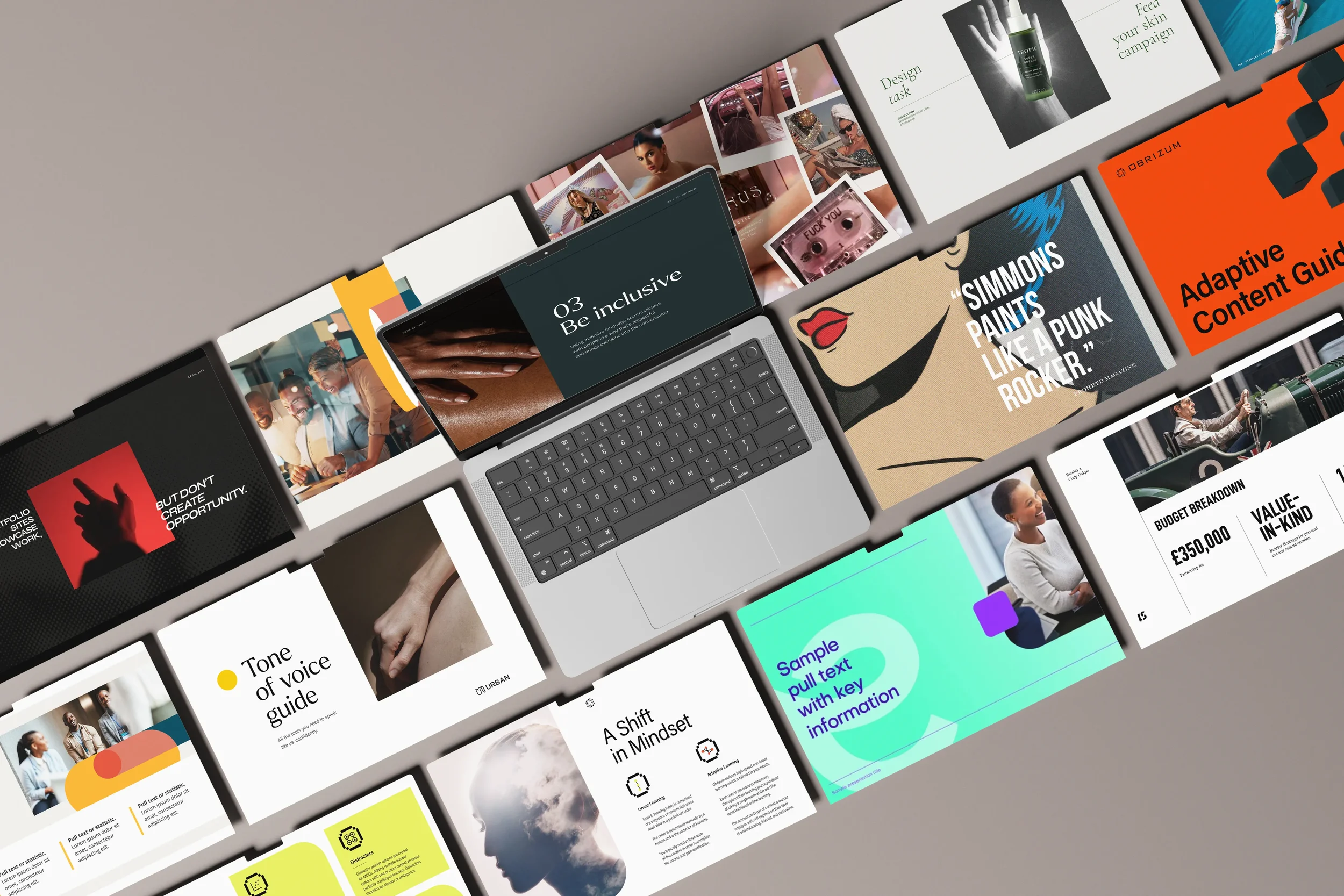
If you’re looking for help making your branded documents tell a great story which feels aligned with who you are, Chromakane can help! Check out our case studies here.
Discover more ideas